

Woodbine Cottage Quilt

Landscape Quilt Contest
In those days in the mid-80’s, I would look in each new Quilt magazine for contests and juried shows in which to enter my work. One such contest was put forth by a new magazine called Quilting, USA, that requested entries of landscape quilts which it planned to publish as a calendar, and there was a $1,000.00 prize. I set out to make a portrait of our “farm”, including a detailed reverse-applique garden, ducks and geese, the house, a tiny barn, a flagpole, and a gravestone for the freed slave who was reported to have been buried on the property. We learned that he had lived there from the previous owners of the house. After that, they told us two sisters from a farming family had kept 2-3 milk cows in the small barn, bringing their milk in cans to a train crossroads nearby. They had done this as long as they could, and were still remembered by people in the community in the 1980s, but the surrounding neighbors’ farms at this time were much larger, and mechanized with milking machines, the milk gathered by semi-trucks.
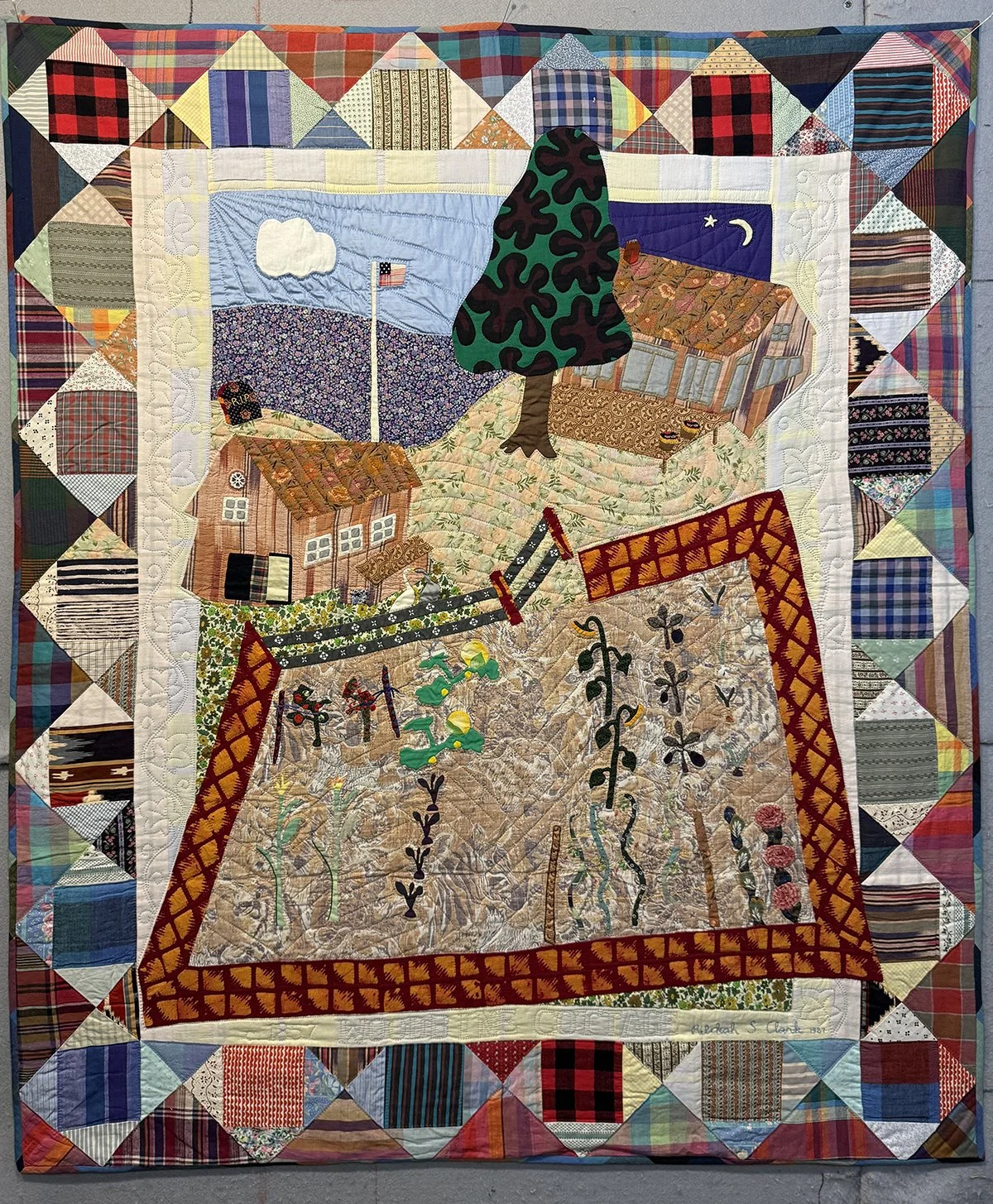
Woodbine Cottage Quilt
I drew a composition on graph paper, and proceeded to select fabrics for the major elements; house, garden, large tree. The large tree became an important part of the composition, made of the same fabric as the Earth had been made in “Heavenly Bodies” from the last post. It was a fabric I had purchased at the Marimekko factory in Helsinki, Finland when I was 15. I had the privilege to travel with my father, in 1968, to visit his new client, Marimekko’s founder, Armi Ratia. I had carefully selected it for its bold pattern of green, brown and black to make a simple gathered miniskirt which I wore nearly to threads before adding it to my stash for quilting. It was a very short skirt, and there wasn’t much of the fabric; probably 1/2 meter. The tree in this piece probably took most of it.
I spent particular effort on the beets in the garden, as I recall, which were fussy to sew. The garden detail I’d hoped for, withered with each stitch, as my real woman sewing skills were challenged by the demands of my imagination. Still, as I look at it now, with the memory of that disappointment, I got more detail than I remembered! To represent the heavily straw-mulched garden I had at the time, I used the back side of a wild animal print.
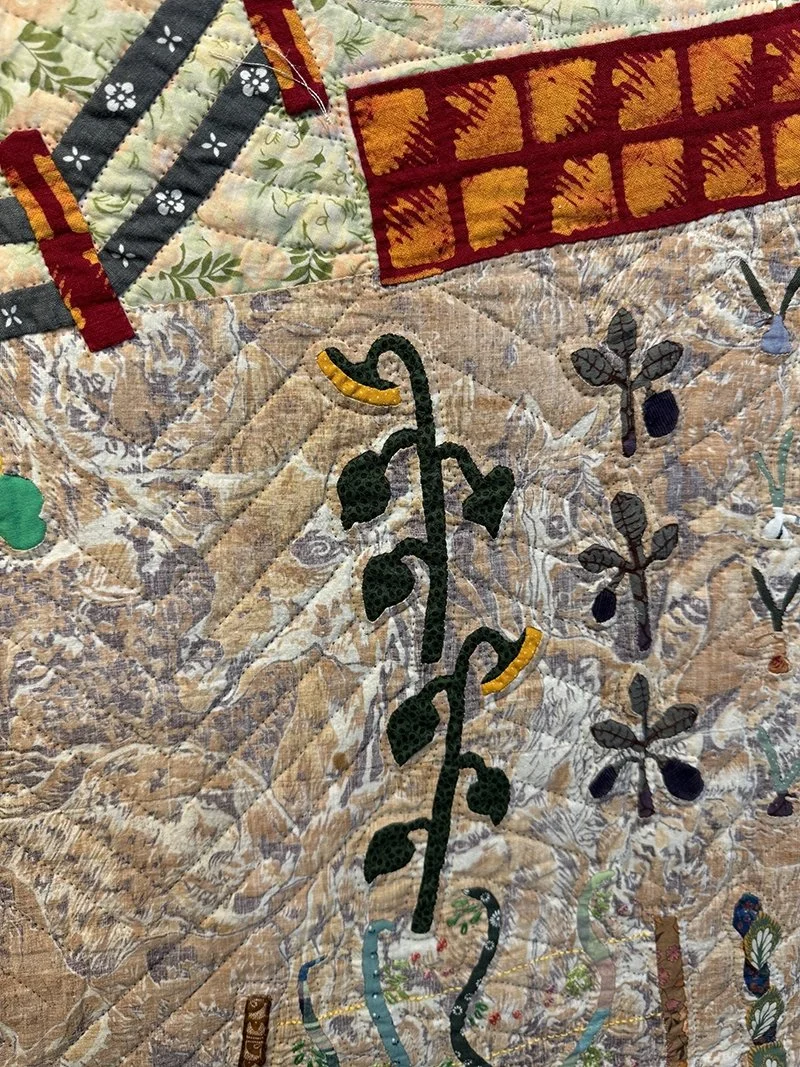
Woodbine Cottage Quilt detail 1

Woodbine Cottage Quilt detail 2
The gravestone for the freed slave was lovingly inscribed RIP and was placed under the tree, where I initially had looked for it, and naively assumed it would be.
A few years after I’d completed the quilt, had won the contest, collected the prize-money, and moved on to other projects, I learned that the grave was located next to the road, Ballina Road; and and I was able to locate a grave-sized depression there, in 1990.
I was sad to learn that the freed slave had not been buried under the tree, nor had he been taken to a churchyard in town. He had been buried next to the road, most likely without ceremony. I hope I put him in a better place, in the loving firmament of my quilt.
