

Woodbine Medallion

Woodbine Medallion was the first quilt I designed on graph paper, and carefully chose and purchased fabric for. It was inspired by Jinny Beyer’s book called “Medallion Quilts” which came out in 1982 just in time for me to be ready for and inspired by it. A medallion quilt is a natural form for a geometric pattern, and especially for a geometric pattern on a surface. It could be anything, one simply designed block, surrounded by a border. If that was not big enough to cover the desired surface, then another border could be added, and so on, the borders themselves could be plain or embellished to please the maker or the design. In those days, geometric blocks featuring points; especially stars were difficult and desirable. Jinny gave excellent directions for making perfect points. Designs could be based on squares, diamonds, hexagons or circles; anything that could be drawn on graph paper could be made in fabric and lie flat on a bed or a wall.
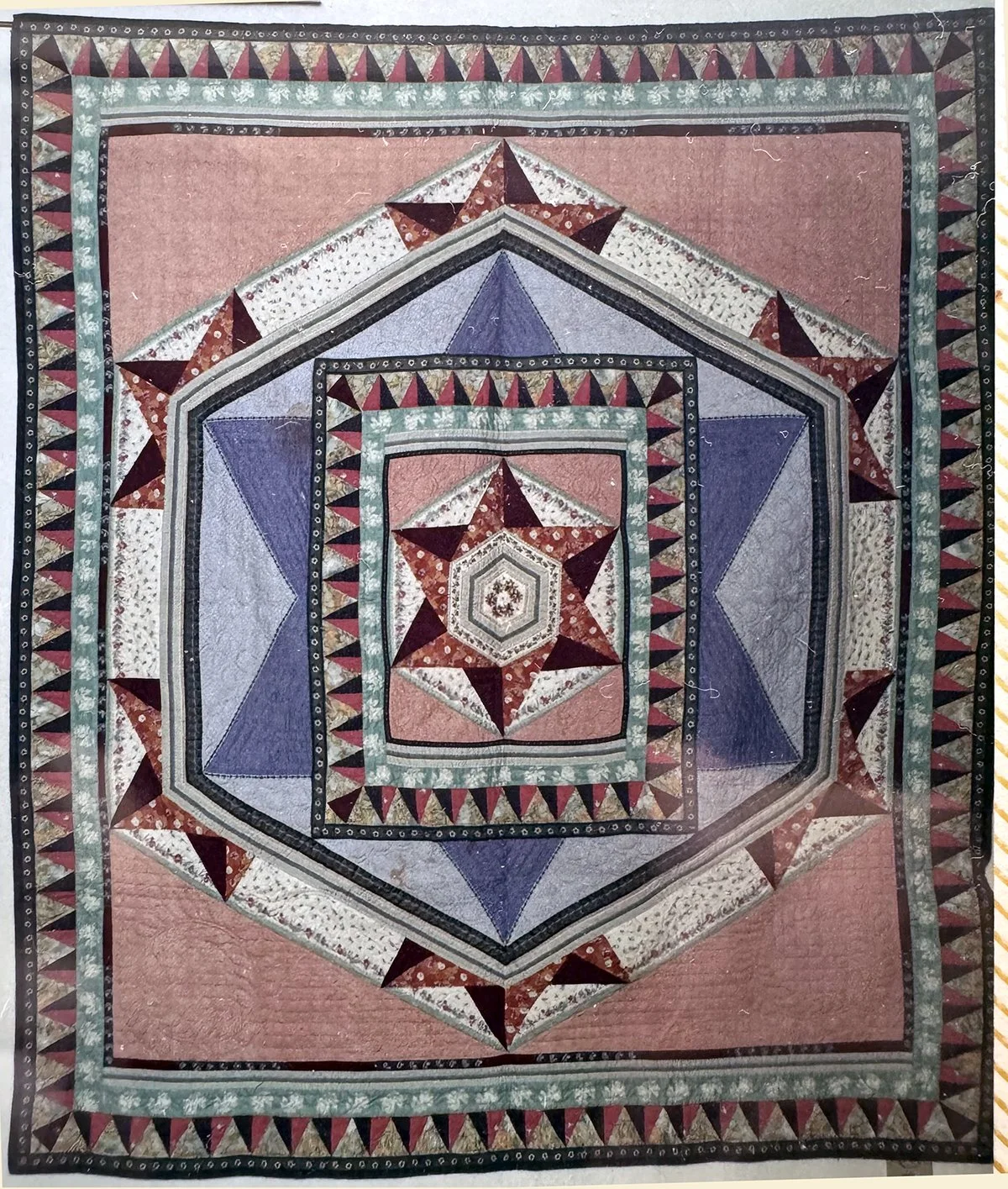
Woodbine Medallion
I spent hours with the graph paper, and hours on the floor with large, then smaller and smaller pieces. I was intensely engaged in this process, and was sure I was making the most beautiful thing I was capable of. I pieced the quilt by hand, while pregnant with my second child, Peter. I remember it becoming more and more difficult to work on the floor and it probably was not too long before I learned to work on a “wall” which, for me was a movable wall; a homasote (pressed fiber board) board covered with felt into which fabric pieces could easily be pinned. When the design was on the wall, it could be left up for awhile, and seen from a distance, and in different lighting across the day and night. I worked on it whenever I could; often in small snippets of time between naps, meals and outings, but I dreamed about it all the time. I worked on finding the right colors to make it “sing”. I was as meticulous as I could be with my tiny stitches, and I was very happy with the results. This quilt, no matter what I have said in earlier posts, was the first quilt that utilized a wool batting, and I carded the wool by hand (it is possible I also borrowed a “drum carder” to do this; I have a faint memory of doing this and of intentionally never doing it again).
My mother was a weaver, and dyed, carded and spun her own yarn, or at least knew how to. She mostly liked to weave finished yarn, but taught herself how to use all the antique tools in the museum (The Essex Institute - Jonathan Ward House) in order to demonstrate their use. During this time she became a journeyman weaver and worked on becoming a master. But my mother was in Massachusetts, and I was in Central New York. I had a friend whose mother was also into wool craft; and it was from her that I borrowed the carder. The batting for this quilt was not as evenly carded as the batting ordered from Bartlett yarns that was used in Etude, but was equally lovely to work with. Still and all, despite the bumps and lumps and not-as-perfect-as-I-would have-liked-piecing (it did not lie perfectly flat, especially at its edges) it pulled a blue ribbon at the New York State Fair in Syracuse in 1983, and won a lot of attention for me, which I enjoyed. I remain proud of this quilt, though I regret to say, the moths have had their way with it.
None of us, alas, are as young as we were. I was also proud of my accomplishment of having two beautiful children, and a beautiful house in the countryside southeast of Syracuse, in Cazenovia, NY. The house was historically notable for having been originally settled by a freed slave; who had arrived on the Underground Railroad (we found an 1857 penny among the bricks outside the old front door, which was, in our day, the door to the basement. The main part of the house had been built above the original cabin, and was lined with wood milled from wood on the property; cherry and butternut, which gave the house a warm earthy glow which was especially lovely in Winter. The previous owners of the property had named the place “Woodbine Cottage” which is where I got the name for the quilt. Sometime later, I made a quilt “picture” of the property, to compete in a landscape-quilt calendar contest, but I will save that story for another day.
